
BMI Calculator: Body Mass Index for Indian Adults
A BMI Calculator uses your height and weight to calculate Body Mass Index (BMI), a simple measure commonly used to classify weight status in adults. It can help you understand whether your weight falls within a commonly used BMI range, but it is important to remember that BMI is a screening measure rather than a complete assessment of health.
For adults, BMI is calculated by dividing weight in kilograms by height in metres squared. The mathematical formula is the same regardless of whether the person is in India or another country. However, the relationship between BMI, body-fat distribution and health risks can differ between populations. For Indian and other Asian populations, this is an important consideration when interpreting a result.
This guide explains how a BMI Calculator works, how to calculate BMI manually, commonly used adult BMI categories, considerations for Indian adults, practical examples, limitations of BMI, and situations where additional health assessment may be appropriate.
What Is BMI?
BMI stands for Body Mass Index. It is a numerical value calculated from a person's body weight and height.
Unlike weight alone, BMI takes height into account. This makes it useful for broad classification of weight status among adults and for population-level health screening.
The standard adult formula is:
BMI = Weight in kilograms ÷ (Height in metres × Height in metres)
The result is normally expressed in kilograms per square metre (kg/m²).
For example, if an adult weighs 70 kg and is 1.75 metres tall:
BMI = 70 ÷ (1.75 × 1.75)
BMI = 70 ÷ 3.0625 ≈ 22.9 kg/m²
An online calculator performs this calculation automatically after you enter your height and weight.
What Does a BMI Calculator Tell You?
A BMI Calculator gives you a calculated BMI value and can place that value into a commonly used adult classification range.
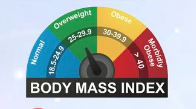
The conventional adult categories are:
| BMI range | General classification |
|---|---|
| Below 18.5 | Underweight |
| 18.5 to 24.9 | Normal or healthy-weight range |
| 25.0 to 29.9 | Overweight |
| 30.0 or higher | Obesity |
These categories are commonly used for adult screening and population-level classification. They should not be interpreted as a diagnosis of an individual's overall health.
Adult Obesity Categories
When BMI is in the obesity range, some classification systems divide it into additional categories:
| BMI range | Classification |
|---|---|
| 30.0 to less than 35.0 | Class 1 obesity |
| 35.0 to less than 40.0 | Class 2 obesity |
| 40.0 or higher | Class 3 obesity |
These labels are classification tools. They do not independently determine whether an individual has a particular medical condition.
BMI Calculator for Indian Standards: What Should You Know?
The phrase Body Mass Index for Indian Standards can be confusing because it may suggest that there is one separate BMI formula exclusively for Indian adults.
The mathematical formula itself does not change based on nationality. An adult's BMI is still calculated from weight and height using the standard formula.
The more important issue is interpretation. Research and international health guidance have recognized that BMI does not necessarily correspond to the same amount or distribution of body fat across different populations. Some Asian populations may experience certain metabolic and cardiovascular risks at lower BMI levels than would be suggested by conventional BMI classifications alone.
For this reason, an Indian adult's BMI can be useful as a screening measurement, but it should be considered together with other relevant health information rather than treated as a standalone diagnosis.
Additional factors may include:
- Waist circumference and abdominal fat distribution
- Blood pressure
- Blood glucose and other metabolic measurements
- Physical activity
- Dietary patterns
- Family history
- Age and sex
- Existing medical conditions
The exact interpretation of these factors depends on the individual. If a BMI result is being used to make an important health decision, additional assessment from a qualified healthcare professional may be appropriate.
How to Use the BMI Calculator
The BMI Calculator is designed to make the mathematical calculation easier. Before entering your information, make sure your height and weight measurements are accurate.
- Measure your current body weight.
- Measure your height accurately.
- Check whether the calculator requires kilograms and metres or provides another unit option.
- Enter your height and weight.
- Calculate your BMI.
- Review the numerical result and the corresponding adult classification.
- Consider the result alongside other relevant health information rather than interpreting it in isolation.
Small measurement errors can affect the final BMI because height is squared in the formula. Using measured values rather than rough guesses can therefore improve the usefulness of the calculation.
How to Calculate BMI Manually
You can calculate adult BMI yourself if you have your weight in kilograms and height in metres.
BMI Formula
BMI = Weight in kg ÷ Height in metres squared
In this formula:
- Weight is your body weight in kilograms.
- Height is your height in metres.
- BMI is the calculated Body Mass Index.
Example 1: 60 kg and 1.65 m
Suppose an adult weighs 60 kg and has a height of 1.65 metres.
BMI = 60 ÷ (1.65 × 1.65)
BMI = 60 ÷ 2.7225 ≈ 22.0 kg/m²
A BMI of approximately 22.0 falls within the conventional adult healthy-weight range of 18.5 to 24.9.
Example 2: 80 kg and 1.70 m
Suppose another adult weighs 80 kg and is 1.70 metres tall.
BMI = 80 ÷ (1.70 × 1.70)
BMI = 80 ÷ 2.89 ≈ 27.7 kg/m²
This result falls within the conventional adult overweight category.
These examples also show why weight should not be considered without height. The same body weight can produce very different BMI values at different heights.
BMI Formula When Height Is in Centimetres
If your height is recorded in centimetres, convert it to metres before using the standard formula.
For example:
170 cm = 1.70 m
You should not enter 170 directly into a formula that expects height in metres. Doing so would produce an incorrect result.
Some online calculators provide centimetre or feet-and-inches inputs and perform the conversion automatically. Even in that situation, it is useful to understand that the underlying metric calculation uses kilograms and metres.
Why BMI Is Useful
BMI remains widely used because it is simple and requires only two basic measurements: height and weight. It can be calculated without specialized body-composition equipment and can be applied consistently across large populations.
For public-health and population-level analysis, BMI can help identify broad patterns in underweight, overweight and obesity.
For an individual, it can provide a starting point for understanding weight relative to height. However, the simplicity of BMI is also its main limitation because the calculation does not include many other factors that influence health.
What BMI Does Not Tell You
A BMI result should not be treated as a complete description of your health.
BMI Does Not Directly Measure Body Fat
BMI is calculated from height and weight. It does not directly measure body-fat percentage, lean mass or muscle mass.
Two people can have the same BMI while having different proportions of muscle and body fat.
BMI Does Not Show Where Fat Is Stored
BMI does not indicate whether body fat is concentrated around the abdomen or distributed elsewhere. Measures such as waist circumference can provide additional information about body-fat distribution.
BMI Can Be Less Informative for Muscular People
A person with substantial muscle mass may have a relatively high BMI because muscle contributes to body weight. The BMI formula cannot distinguish muscle from fat.
A Normal BMI Does Not Guarantee Good Health
A BMI within the conventional healthy-weight range does not automatically mean that every aspect of a person's health is normal. Other factors, including blood pressure, blood glucose, fitness, lifestyle and medical history, can also matter.
A High BMI Is Not a Diagnosis by Itself
A BMI in the overweight or obesity range is a screening result, not a diagnosis of a specific health condition. Interpretation should take the individual's circumstances and other health measurements into account.
BMI for Men and Women
The standard adult BMI formula is the same for men and women:
BMI = Weight in kilograms ÷ Height in metres squared
However, using the same formula does not mean that body composition or fat distribution is identical between men and women.
Sex, age, muscle mass, body-fat distribution and other characteristics can affect how a BMI result should be understood. BMI therefore provides only one part of a broader assessment.
Can You Use an Adult BMI Calculator for Children?
No. Standard adult BMI categories should not generally be used to interpret the BMI of children and adolescents.
Children and teenagers are still growing, and body composition changes with age. Their BMI is therefore interpreted using age- and sex-specific references rather than simply applying adult thresholds such as 18.5, 25 and 30.
If you are checking BMI for a child or teenager, use an age-appropriate pediatric reference and seek qualified healthcare guidance when necessary.
How Should You Interpret Your BMI Result?
It can be tempting to treat BMI as a pass-or-fail score. A more useful approach is to regard it as one measurement within a larger picture.
For example, a BMI of 23 and a BMI of 24.9 are both within the conventional healthy-weight range, but the two individuals can have very different health profiles.
Likewise, a change from 29.9 to 30.0 changes the classification label, but the difference of 0.1 BMI does not represent a sudden change in health.
BMI categories use numerical thresholds because they are useful for classification and screening. Health-related risk, however, does not necessarily change abruptly at a single decimal point.
BMI and Waist Circumference
Because BMI does not describe where body fat is stored, waist circumference can provide additional information about body size and abdominal fat distribution.
Depending on the circumstances, a broader assessment may also consider blood pressure, blood glucose, lipid measurements, physical activity, diet and medical history.
For Indian adults in particular, considering multiple indicators can help avoid treating a single BMI number as a complete measure of metabolic or cardiovascular health.
Using BMI When Working Toward Weight-Loss Goals
Many people use a BMI Calculator because they are interested in weight management. BMI can provide a starting reference, but it does not need to become the only number you monitor.
Useful measures may include changes in body weight over time, waist measurement, physical activity and other health indicators that are relevant to the individual.
General healthy habits may include:
- Maintaining a balanced eating pattern.
- Participating in appropriate regular physical activity.
- Monitoring longer-term weight trends rather than focusing on a single measurement.
- Considering waist measurement and other relevant health indicators.
- Allowing reasonable time for changes rather than expecting immediate results.
- Seeking professional guidance when there is a significant health or weight concern.
A calculator can provide information, but it cannot create a personalized health plan or determine an appropriate target for every individual.
BMI Calculator vs. Other Health Calculators
Different health calculators answer different questions. BMI should not be confused with tools that estimate calorie requirements, body weight references or other measurements.
| Tool or measurement | What it generally provides |
|---|---|
| BMI Calculator | Weight relative to height and a broad BMI classification |
| Ideal Weight Calculator | An estimated reference or target weight based on a selected formula |
| Calorie Calculator | An estimate of calorie requirements based on entered characteristics and assumptions |
| Waist Measurement | Information about body size and abdominal fat distribution |
These measurements are not interchangeable. No single calculator can determine what weight or health status is appropriate for every individual.
Tips for Getting a More Reliable BMI Calculation
- Use an accurate weighing scale: Avoid relying on an old or inconsistent measurement when accuracy matters.
- Measure your height correctly: Stand upright and use a consistent measurement method.
- Check the units: Confirm whether the calculator expects kilograms and metres or supports other units.
- Use measured values: Avoid entering rough estimates when accurate measurements are available.
- Consider trends: Repeated measurements taken under reasonably similar conditions can be more informative than one isolated result.
- Do not overinterpret small changes: Normal changes in body weight and measurement conditions can affect the calculated BMI slightly.
Common BMI Calculator Mistakes to Avoid
1. Entering Centimetres as Metres
Entering 170 as height into a formula that expects metres instead of converting it to 1.70 will produce an incorrect calculation.
2. Mixing Pounds and Kilograms
If your weight is recorded in pounds but the calculator expects kilograms, convert the value first unless the calculator specifically supports pounds.
3. Applying Adult Categories to Children
Children and adolescents require age- and sex-specific BMI interpretation. Adult thresholds should not be applied to them as if they were adults.
4. Treating BMI as Body-Fat Percentage
BMI is a weight-for-height index. It is not a direct measurement of body-fat percentage.
5. Assuming a Normal BMI Means Perfect Health
A BMI within the conventional healthy range is useful information, but it does not assess every aspect of physical health.
6. Assuming a High BMI Automatically Describes Fitness
Muscle mass can contribute substantially to body weight. BMI cannot distinguish muscle from fat, which is one reason it should be interpreted as a screening measure.
7. Looking for One Perfect BMI Number
Health is not determined by one exact decimal. BMI ranges are broad classification tools, while individual health assessment requires more information.
When Should You Consider Professional Health Guidance?
An online BMI calculation can be useful for general information, but additional professional assessment may be appropriate when a BMI result is causing concern or when other risk factors are present.
Consider discussing your situation with a qualified healthcare professional if:
- Your BMI is substantially outside the conventional adult range.
- Your weight has changed rapidly without an obvious explanation.
- You have concerns about blood pressure, blood sugar, cholesterol or other health measurements.
- You are considering a major weight-loss or weight-gain program.
- You are pregnant.
- You are calculating BMI for a child or teenager.
- You have a medical condition or take medication that may affect your weight.
- You are uncertain about how population-specific BMI risk information applies to you.
A healthcare professional can consider information that a basic BMI Calculator cannot measure.
BMI Calculator Quick Reference
| Question | Answer |
|---|---|
| What does BMI stand for? | Body Mass Index |
| What is the adult BMI formula? | Weight in kilograms divided by height in metres squared |
| What is generally classified as underweight? | BMI below 18.5 |
| What is the conventional healthy-weight range? | BMI from 18.5 to 24.9 |
| What is generally classified as overweight? | BMI from 25.0 to 29.9 |
| What is generally classified as obesity? | BMI of 30.0 or higher |
| Does BMI diagnose health conditions? | No. BMI is a screening measurement. |
| Can adult BMI categories be used for children? | No. Children require age- and sex-specific interpretation. |
| Does BMI measure muscle mass? | No. BMI does not distinguish muscle from fat. |
Frequently Asked Questions
What is a healthy BMI for an adult?
Under the commonly used adult classification, a BMI from 18.5 to 24.9 falls within the conventional healthy-weight range. However, BMI is a screening measure and should not be treated as a complete assessment of health.
Is the BMI formula different for Indians?
The mathematical formula does not change simply because a person is Indian. What can differ is the relationship between BMI, body-fat distribution and certain health risks across populations. Indian adults should therefore consider BMI alongside other relevant health factors.
Is BMI accurate for people with high muscle mass?
BMI may be less informative for people with substantial muscle mass because it uses total body weight and cannot distinguish muscle from fat. Two people with the same BMI can have different body compositions.
Can I use an adult BMI Calculator for my child?
No. Children and adolescents should generally be assessed using age- and sex-specific BMI references rather than adult BMI categories.
Does BMI tell me my exact body-fat percentage?
No. BMI is a weight-for-height calculation. It does not directly measure body-fat percentage, muscle mass or the distribution of body fat.
Should I try to reach one exact BMI number?
Not necessarily. BMI ranges are useful for broad classification, but overall health depends on multiple factors. A qualified healthcare professional can help interpret BMI alongside other relevant measurements and personal circumstances.
Official Sources and Further Reading
The BMI classifications and interpretation discussed in this article are based on the general adult BMI framework described in the source material, including guidance associated with organizations such as the World Health Organization and the U.S. Centers for Disease Control and Prevention. Because health guidance and population-specific recommendations can change, check the latest information from the relevant official health authority when a medical decision depends on it.
Use the BMI Calculator
You can use the BMI Calculator to calculate your BMI from your height and weight without performing the formula manually.
The result is an estimated mathematical calculation based on the information you enter. It should be used for general educational and screening purposes rather than as a diagnosis or personalized medical recommendation.
About the Author
B. Kumar is the Founder & Developer of Discount Calculator, a website that provides online calculators and practical explanations for financial, tax, shopping and everyday calculations. The site's calculators are designed to help users understand calculations, formulas, assumptions and estimated results.
Written by: B. Kumar, Founder & Developer, Discount Calculator
Important Disclaimer
Financial and tax information on Discount Calculator is provided for general educational and informational purposes. Calculator results are estimates based on user-provided information and the assumptions described on the relevant page. We do not provide personalized financial, investment, tax or legal advice. Rates, rules, fees and regulatory requirements may change. For important decisions, verify information with the relevant government authority, financial institution or qualified professional.