
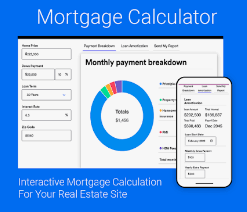
Free Mortgage Calculator – Estimate EMI, Interest and Home Loan Cost
Buying a home usually involves a long-term financial commitment. The property price is only one part of the calculation. The amount borrowed, interest rate, repayment period, down payment, fees and other property-related expenses can all affect the overall cost.
A Free Mortgage Calculator can help you estimate the monthly EMI, total interest and total repayment for a home loan. It can also help you compare different loan amounts, interest rates and repayment periods before you review an actual lender offer.
The result from an online calculator is a mathematical estimate based on the information entered. It should not be treated as a loan approval, quotation or personalized financial advice. Actual repayment obligations depend on the lender, loan agreement, interest structure, payment schedule, fees and other applicable conditions.
What Is a Mortgage Calculator?
A mortgage calculator is an online tool that estimates the periodic payment required to repay a property loan over a specified period. For a standard reducing-balance loan, the calculation primarily uses the loan principal, periodic interest rate and number of payments.
For home-loan planning, the terms mortgage and home loan may be used differently depending on the country. The underlying EMI mathematics can still be useful when estimating an Indian home loan, provided the assumptions used by the calculator match the loan structure.
A calculator may require some or all of the following inputs:
- Property price
- Down payment
- Loan amount
- Annual interest rate
- Loan tenure
- Number of monthly payments
- Additional principal payments, where supported
Some mortgage tools may also allow users to consider taxes, insurance or other housing expenses. These should be kept separate from the EMI calculation unless the calculator specifically includes them.
What Can a Free Mortgage Calculator Tell You?
A basic mortgage calculator can answer several practical questions before you approach a lender:
- What could the monthly EMI be?
- How much interest could be paid over the full tenure?
- What would the total repayment be?
- How does a different loan amount affect the EMI?
- What happens if the repayment period changes?
- How sensitive is the payment to a different interest-rate assumption?
For example, if you are considering a ₹40 lakh home loan, you can compare different interest-rate and tenure assumptions instead of looking at only one EMI figure.
Mortgage EMI Formula
For a standard reducing-balance loan with a fixed periodic rate, the commonly used EMI formula is:
EMI = P × r × (1 + r)n ÷ [(1 + r)n − 1]
Where:
- P = loan principal
- r = monthly interest rate expressed as a decimal
- n = total number of monthly instalments
If the annual interest rate is 8%, a simplified monthly-rate assumption would be 8% ÷ 12, or approximately 0.006667 expressed as a decimal.
The formula assumes a particular repayment structure. Actual lender calculations may differ because of the loan's interest method, payment dates, rounding, rate resets, disbursement timing, fees and contractual terms.
How to Calculate a Home Loan EMI
The calculation can be understood in a few steps.
- Determine the amount you plan to borrow.
- Convert the applicable annual interest rate into the periodic rate used by the calculation.
- Determine the total number of instalments from the loan tenure.
- Apply the EMI formula.
- Multiply the EMI by the number of instalments to estimate total repayment under the same assumptions.
- Subtract the original principal from the estimated total repayment to calculate the corresponding interest amount.
For a simplified fixed-rate calculation:
Total Repayment = EMI × Number of Monthly Payments
Total Interest = Total Repayment − Loan Principal
These calculations describe the mathematical result under the stated assumptions. They do not include costs that are outside the formula.
Worked Example: ₹40 Lakh Home Loan
Consider a hypothetical home loan of ₹40,00,000 with an assumed annual interest rate of 8% and a tenure of 20 years.
| Loan Detail | Illustrative Value |
|---|---|
| Loan amount | ₹40,00,000 |
| Annual interest rate | 8% |
| Tenure | 20 years |
| Total monthly payments | 240 |
| Approximate monthly EMI | ₹33,458 |
| Approximate total repayment | ₹80.30 lakh |
| Approximate total interest | ₹40.30 lakh |
This is an illustration using the standard reducing-balance EMI formula. The interest rate is an example assumption, not a statement about a currently available home-loan rate.
The example also shows why looking only at the monthly EMI can be misleading. A loan that appears manageable each month can involve a substantial amount of interest when it remains outstanding for many years.
How Property Price, Down Payment and Loan Amount Are Connected
The property price and loan amount are not necessarily the same number. A down payment reduces the amount that needs to be borrowed.
A simplified calculation is:
Loan Amount = Property Price − Down Payment
For example, if a property costs ₹60 lakh and the assumed down payment is ₹15 lakh:
₹60 lakh − ₹15 lakh = ₹45 lakh loan amount
This simplified calculation does not mean that the buyer's total cash requirement is only ₹15 lakh. Depending on the transaction, there may also be taxes, registration expenses, documentation costs, insurance, lender charges, moving expenses or other costs.
How Down Payment Affects the Calculation
A larger down payment generally means a smaller loan principal when other assumptions remain unchanged. A smaller principal means less money is subject to interest under the same loan terms.
| Property Price | Illustrative Down Payment | Illustrative Loan Amount |
|---|---|---|
| ₹50 lakh | ₹5 lakh | ₹45 lakh |
| ₹50 lakh | ₹10 lakh | ₹40 lakh |
| ₹50 lakh | ₹15 lakh | ₹35 lakh |
| ₹50 lakh | ₹20 lakh | ₹30 lakh |
This table only demonstrates the relationship between purchase price, down payment and borrowing. It does not establish how much a particular lender will finance or how much cash a buyer should contribute.
When planning a purchase, the down payment should also be considered alongside emergency savings and other immediate property expenses.
Why Loan Tenure Matters
Loan tenure affects both the monthly EMI and the cumulative interest calculated over the repayment period.
With the same principal and interest-rate assumption, extending the tenure generally spreads repayment over more months. This can reduce the scheduled EMI, but interest can accumulate over a longer period.
| Tenure Scenario | Monthly Payment | Total Interest | General Effect |
|---|---|---|---|
| Shorter tenure | Higher | Generally lower | Faster repayment |
| Medium tenure | Moderate | Moderate | Intermediate repayment period |
| Longer tenure | Lower | Generally higher | Loan remains outstanding longer |
These are general mathematical relationships rather than recommendations about which tenure a particular borrower should select.
Mortgage EMI vs Total Housing Cost
The EMI calculated from principal, interest rate and tenure should not automatically be treated as the complete monthly cost of owning a home.
Depending on the property, loan and jurisdiction, a homeowner may also have expenses such as:
- Property-related taxes
- Insurance
- Maintenance and repairs
- Society or association charges
- Utilities
- Loan processing or other lender charges
- Registration and transaction expenses
- Other property-specific costs
Some calculators include selected additional costs, while others calculate only principal and interest. Always check what the result represents before comparing it with a lender's quoted payment.
How to Use a Free Mortgage Calculator
- Enter the loan amount: Use the amount you actually expect to borrow rather than automatically entering the full property price.
- Enter the interest rate: Use the rate stated in the lender's offer when available. If you are only planning, clearly treat the rate as an assumption.
- Enter the tenure: Select the expected repayment period in years or months, depending on the calculator.
- Calculate the EMI: Review the estimated periodic payment.
- Check total interest: Compare the interest with the original principal to understand the longer-term borrowing cost.
- Compare scenarios: Change one input at a time to see how the result changes.
- Verify the final figures: Once you have an actual lender offer, compare the calculator assumptions with the official loan documents.
Compare Different Mortgage Scenarios
A calculator becomes more useful when it is used for scenario analysis rather than a single calculation.
You can compare:
- A smaller versus larger loan amount
- Different down-payment assumptions
- Different repayment periods
- Different interest-rate assumptions
- Additional principal payments, where supported
For example, if your initial calculation uses an 8% interest-rate assumption, you can also calculate the same loan using a higher assumed rate. This does not predict future rates. It simply demonstrates how sensitive the payment is to a change in the input.
Fixed-Rate and Floating-Rate Home Loans
Fixed-Rate Loans
Under a fixed-rate structure, the applicable interest rate remains fixed for the period specified by the loan agreement. If the loan terms and payment schedule remain unchanged, the principal-and-interest payment can be easier to estimate.
Floating-Rate Loans
A floating-rate loan can change according to the applicable benchmark, reset mechanism and loan terms. A change in the rate can affect the EMI, the repayment period or both, depending on the arrangement.
For this reason, a single EMI calculation may not fully represent the possible future payment path of a floating-rate loan. Running alternative rate assumptions can help illustrate the mathematical effect of a rate change.
Rates, lending rules and applicable requirements can change. For an actual home loan in India, check the latest information in the lender's documents and relevant official regulatory guidance.
Understanding Mortgage Amortization
Amortization describes how scheduled loan payments reduce the outstanding principal over time.
For a typical amortizing loan, each payment has an interest component and a principal component. At the beginning of the loan, the outstanding balance is larger, so the interest component can represent a larger portion of the payment. As the principal balance declines, the interest calculated on that balance generally declines as well.
| Loan Stage | Interest Component | Principal Component | Outstanding Balance |
|---|---|---|---|
| Early payments | Generally larger | Generally smaller | High |
| Middle period | Declining | Increasing | Declining |
| Later payments | Generally smaller | Generally larger | Low |
The exact allocation depends on the loan terms and calculation method. An amortization schedule can provide a more detailed view of how each payment affects the balance.
How Extra Payments Affect a Home Loan
An additional payment toward principal can reduce the outstanding loan balance. If future interest is calculated on that lower balance, the additional payment may reduce future interest under the applicable loan terms.
A calculator can be used to compare the original repayment schedule with a hypothetical additional payment. Depending on the lender's terms, the effect may be represented through a shorter repayment period, a changed payment amount, or another adjustment.
Before making an additional payment, check the loan agreement and applicable prepayment conditions. The actual benefit depends on how the lender applies the payment and how interest is calculated.
How to Assess Home-Loan Affordability
A mortgage calculator can estimate what a particular loan would cost mathematically, but affordability involves more than the calculated EMI.
Consider the complete household budget, including:
- Monthly income
- Existing loan payments
- Regular household expenses
- Insurance costs
- Education and family expenses
- Emergency savings
- Property maintenance
- Utilities
- Property-related taxes and charges
- Other regular financial commitments
A useful calculation starts with a realistic monthly budget and then tests different loan amounts and assumptions. The maximum amount that can be mathematically borrowed is not necessarily the same as an amount that fits comfortably within an individual's overall finances.
How to Compare Home-Loan Offers
Comparing only the advertised interest rate can leave out important parts of a loan agreement.
When reviewing actual offers, compare the applicable:
- Loan amount
- Interest rate
- Fixed or floating structure
- Loan tenure
- EMI or periodic payment
- Total interest under the stated assumptions
- Processing and other applicable fees
- Prepayment conditions
- Late-payment charges
- Insurance requirements, where applicable
- Other contractual terms
Use the same loan amount, rate assumptions and tenure when comparing mathematical scenarios. Then compare those estimates with the actual lender documents.
Mortgage Calculator vs EMI Calculator
The two terms can overlap, but they may have different practical emphasis.
A Mortgage Calculator is generally focused on property financing and may include inputs such as property price, down payment and housing-related expenses.
An EMI Calculator primarily focuses on the periodic payment for a loan based on the principal, interest rate and tenure.
For detailed loan-payment calculations, a dedicated EMI calculator can be useful when you already know the expected loan amount and want to study repayment scenarios.
Common Mortgage Calculator Mistakes
1. Looking Only at the EMI
A lower EMI can result from a longer repayment period. Compare total interest and total repayment rather than relying on the monthly figure alone.
2. Treating an Assumed Rate as a Confirmed Rate
If you are planning before receiving a lender offer, clearly identify the interest rate as an assumption. Replace it with the actual contractual rate when available.
3. Ignoring Rate Changes
For a floating-rate loan, a calculation based on one interest rate may not describe every future payment. Test alternative rates to understand the mathematical sensitivity.
4. Entering the Property Price as the Loan Amount
If a down payment is being made, the expected borrowing amount may be lower than the purchase price. Additional purchase expenses should also be considered separately.
5. Forgetting Non-EMI Costs
Maintenance, taxes, insurance, utilities, registration expenses and other costs can affect the overall cost of owning a property.
6. Assuming the Calculator Is the Lender's Final Calculation
An online calculator applies a formula to the inputs supplied. The lender's agreement determines the actual repayment obligation.
7. Ignoring Prepayment Conditions
If you expect to make additional payments, check the applicable loan terms before relying on a projected interest saving.
8. Comparing Loans With Different Assumptions
A comparison is difficult to interpret if the loan amount, tenure, interest rate or other assumptions change at the same time. Compare like-for-like scenarios whenever possible.
Example: Comparing Loan Tenures
Suppose the same hypothetical principal and interest-rate assumption are used for three different repayment periods. The shorter period will generally produce a higher scheduled EMI, while the longer period spreads repayment over more months.
| Scenario | Loan Amount | Interest Assumption | Tenure | What to Examine |
|---|---|---|---|---|
| A | Same principal | Same rate | Shorter | Higher EMI and lower cumulative interest tendency |
| B | Same principal | Same rate | Medium | Intermediate payment and interest profile |
| C | Same principal | Same rate | Longer | Lower EMI and longer interest period |
The purpose of this comparison is to understand the relationship between tenure, EMI and interest. It is not a recommendation to select a particular repayment period.
What a Mortgage Calculator Does Not Tell You
A calculator cannot determine every part of an actual home-loan transaction. Depending on the tool, it may not account for:
- Individual lender eligibility criteria
- The final interest rate offered to a borrower
- Loan-specific fees and charges
- Property valuation or legal requirements
- Changes to a floating interest rate
- Payment-date differences
- Actual disbursement timing
- Taxes and registration costs
- Property insurance or maintenance
- Special contractual conditions
- How a lender applies an additional payment
For these reasons, the calculator should be treated as a planning and comparison tool rather than a substitute for official loan documents.
When the Calculated Result May Differ From the Actual EMI
Differences can occur when the assumptions used by the calculator do not exactly match the lender's methodology.
For example, the calculator may assume a regular monthly payment and a constant interest rate, while the actual loan may involve rate resets, different payment dates, staged disbursements, rounding rules or other contractual provisions.
The safest way to verify an actual repayment obligation is to compare the calculator inputs with the lender's official repayment schedule and loan agreement.
Frequently Asked Questions
Is a Free Mortgage Calculator the same as an EMI calculator?
Not necessarily. An EMI calculator generally focuses on the periodic loan payment, while a mortgage calculator may also consider property price, down payment and other housing-related inputs. The exact features depend on the calculator.
Can I use a mortgage calculator for an Indian home loan?
Yes, the standard EMI mathematics can be used to estimate an Indian home loan when the calculator's assumptions match the loan structure. Actual lender calculations should always be verified against the applicable loan documents.
Does a longer tenure reduce the total cost of a home loan?
A longer tenure generally lowers the scheduled EMI when other assumptions remain unchanged, but it can increase the cumulative interest because the loan remains outstanding for a longer period. The actual result depends on the loan terms.
Does a larger down payment reduce home-loan interest?
If the larger down payment results in a smaller principal and the other loan terms remain unchanged, less principal is subject to interest. This can reduce the calculated interest cost. The effect on a particular loan should be evaluated using its actual terms.
Can extra payments reduce home-loan interest?
An additional payment toward principal can reduce the outstanding balance and may reduce future interest under the applicable repayment structure. The exact benefit depends on the loan agreement and how the lender applies the payment.
How accurate is a mortgage calculator?
A calculator can correctly perform the mathematical calculation based on its inputs and formula. That does not mean the result will exactly match a lender's final figure. Fees, rate changes, payment timing, rounding, taxes, insurance and loan-specific terms can produce differences.
Official Sources and Further Reading
Mortgage and home-loan rules, rates, fees and disclosure requirements can change. For an actual borrowing decision, check the latest information from the relevant official authority and the lender's current loan documents.
For Indian home loans, relevant information may be available through the Reserve Bank of India and the applicable lender. Where a tax, regulatory or legal issue affects the transaction, verify the current position with the appropriate official authority.
About the Author
B. Kumar is the Founder & Developer of Discount Calculator, a website that provides online calculators and practical explanations for financial, tax, shopping and everyday calculations. The site's calculators are designed to help users understand calculations, formulas, assumptions and estimated results.
Written by: B. Kumar, Founder & Developer, Discount Calculator
Important Disclaimer
Financial and tax information on Discount Calculator is provided for general educational and informational purposes. Calculator results are estimates based on user-provided information and the assumptions described on the relevant page. We do not provide personalized financial, investment, tax or legal advice. Rates, rules, fees and regulatory requirements may change. For important decisions, verify information with the relevant government authority, financial institution or qualified professional.